For ENT outpatient clinics · Pre-pilot
A structured consultation pad for ENT clinics. AI may suggest. The clinician decides.
Finish a structured ENT consultation, prescription and signed note in one workflow, while AI suggestions stay out of the record until you approve the exact finding.
It makes no clinical decisions. Nothing an AI suggests becomes part of the chart without your explicit review and approval.
Become a design partnerWatch a visit (1 minute)
Not for consequential clinical use. Not yet used with real patients.
How the note becomes trustworthy.
1
Capture
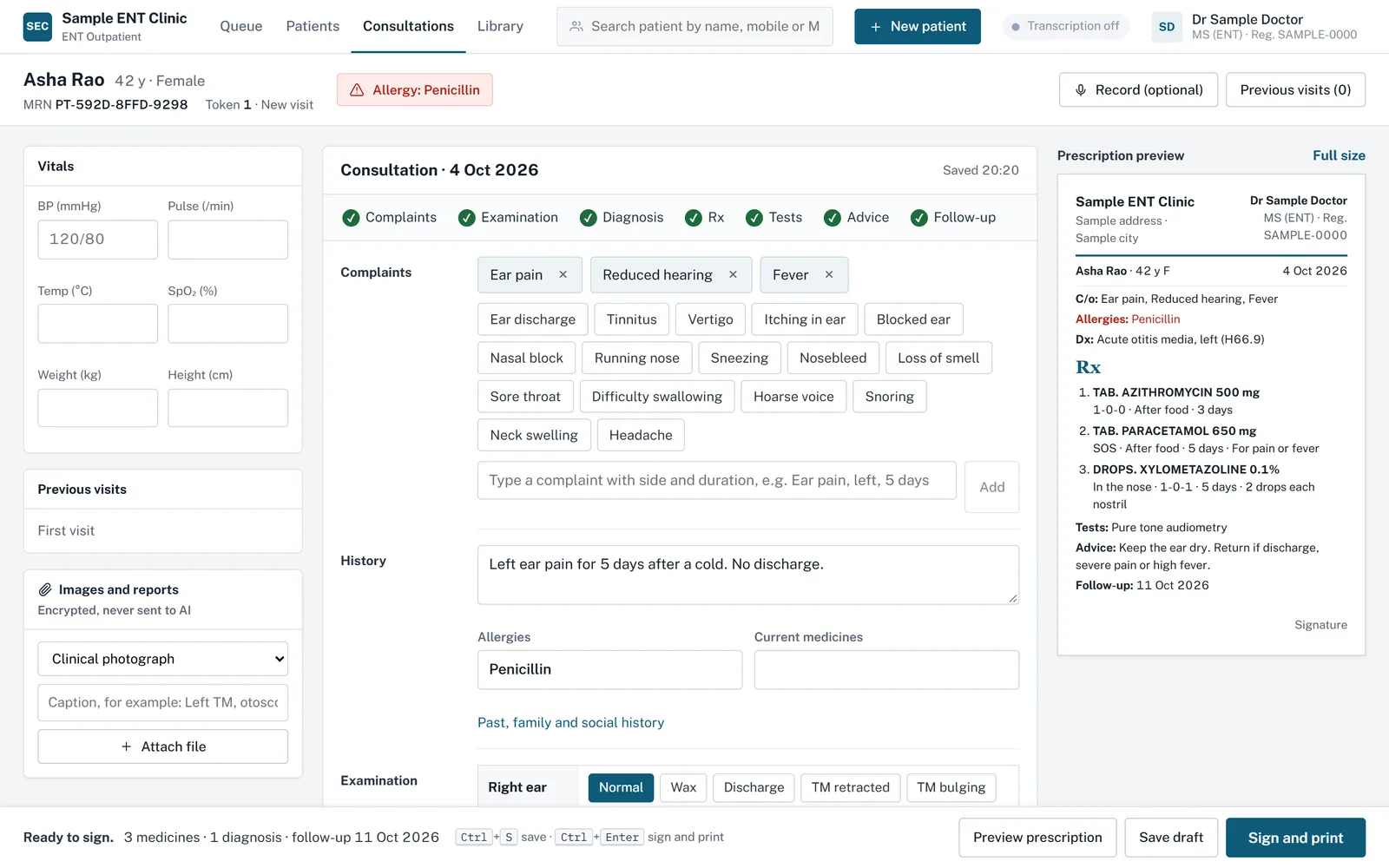
You fill a structured pad: complaints, an examination grid for ear, nose and throat, diagnosis with ICD-10, medicines with dose and route. If you choose to record, the app also proposes findings it heard, each with the exact words they came from.
2
Review
Every proposal waits for you. Accept, edit, hold or reject it. Nothing an AI suggests is inserted into the note on its own, and the note cannot be signed while a proposal is still waiting.
3
Sign
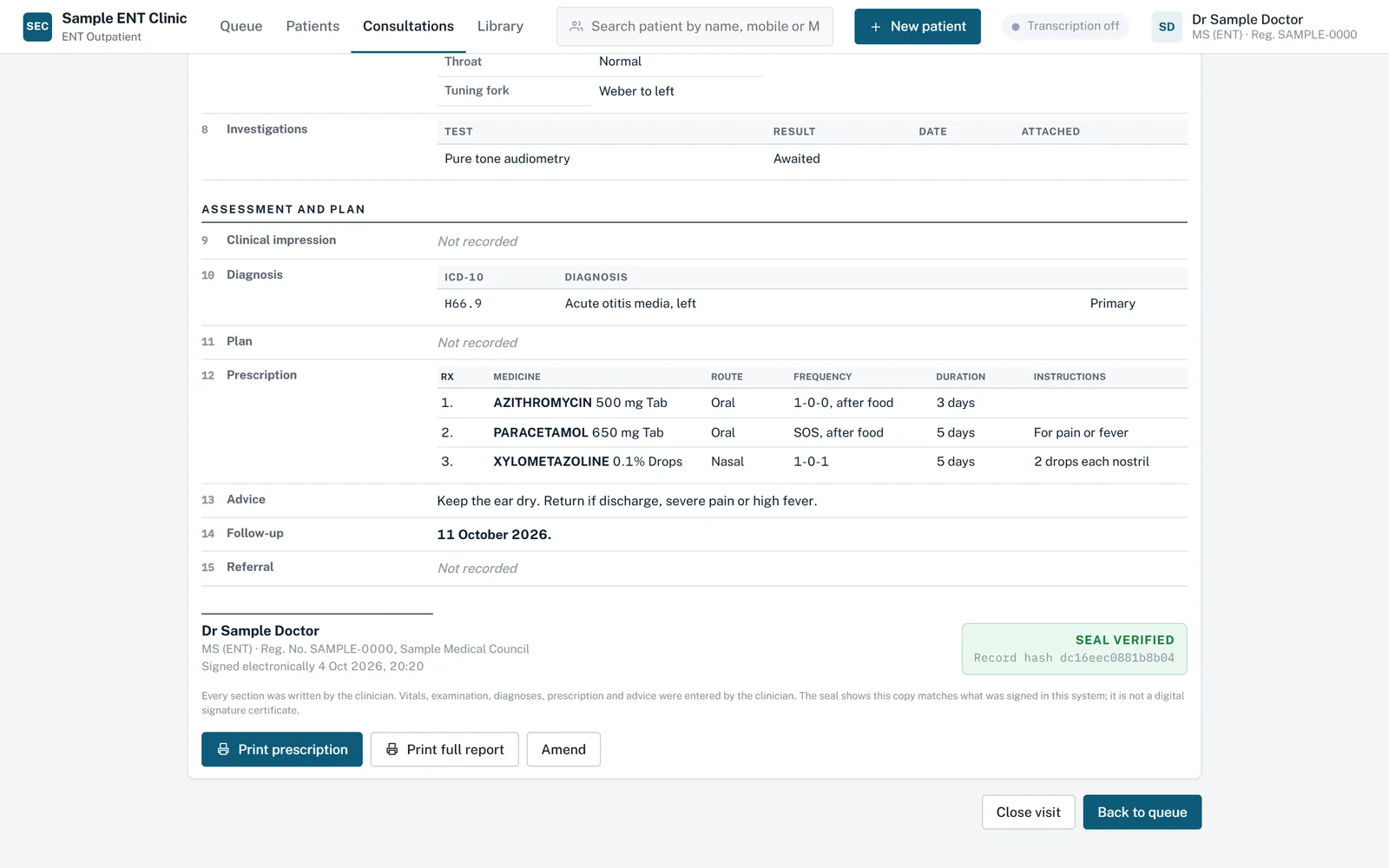
You sign the exact note you see. It is sealed, printed with your name, qualification and registration number, and kept with a record of who changed what, and why.
What it does.
- Structured ENT notes: complaints, history, examination by site, diagnosis with ICD-10, prescription, tests, advice and follow-up.
- A queue with tokens and quick registration for the front desk.
- Signed, sealed notes and a one-page prescription with your registration number.
- With recording and consent: proposes examination findings from your words, with the quote behind each one.
- With recording, as a research feature: a separate panel can list possible diagnoses and options for you to consider. It is not validated, and a line from it enters the note only if you click to add it.
What it does not do.
- Make clinical decisions. The doctor decides every finding, diagnosis and medicine.
- Write to the chart on its own. AI suggestions stay outside the note until you approve them.
- Prescribe. Every medicine is typed or picked by you.
- Replace a hospital system: no billing, pharmacy or inpatient records.
- Hold any certification or approval for clinical use. It is pre-pilot.
What works today.
Tested means the code has passing tests for that claim. Built means the code exists and works in our own runs, without a test for that claim yet.
- TestedA finding the app proposes enters the note only after the doctor accepts that exact finding.
- TestedExamination findings are proposed only from the doctor's words, never from the patient's.
- TestedA signed note is sealed. Any later change to it shows as a broken seal.
- TestedAn amendment needs a reason and keeps the earlier signed version.
- TestedA medicine cannot be signed without a route, so nose drops never print as oral.
- TestedPatient details, notes, recordings and attachments are stored encrypted on the clinic's own computer.
- BuiltOne-page consultation pad, patient queue with tokens, and quick registration.
- BuiltYour registration number prints on every prescription. Signing waits until it is added.
- BuiltA warning when a medicine is in a family the patient is allergic to: penicillins, sulfonamides, NSAIDs.
- BuiltOptional recording with the doctor's and patient's voices told apart, in Indian languages, written up in English.
What is not there yet.
- Not yetUsed with real patients. Recording has not been tried in a live consultation.
- Not yetMeasured time saved per visit. We will publish it from design-partner evaluations, not before.
- Not yetENT finding lists reviewed by practising ENT surgeons.
- Not builtABDM linking. The ABHA number is stored, not verified or linked.
- Not coveredA full drug-interaction database. The allergy check is a short list and does not replace your own check.
Where the data goes.
Stays in the clinic
The app runs on a computer in your clinic. Patient details, notes, prescriptions, photos and reports are stored there, encrypted.
Leaves only if you record
Recording is optional and needs the patient's consent. When you use it, audio goes to Sarvam AI for transcription, under Sarvam's terms. Photos and reports are never sent to any AI service.
You hold the authority
Only a signed-in clinician can accept a finding or sign a note. Every view, change and signature is written to an audit log.
Design partnership
Looking for five to ten ENT clinics.
We are looking for private ENT clinics with one to five doctors, a busy outpatient list, and notes kept on paper, in Word, or across several tools. Most of all, a doctor who feels the documentation load personally.
What we offer: we set the workflow up around your clinic, run a tightly controlled evaluation with synthetic or approved non-consequential data, measure documentation time and how often notes need correcting, and publish results only with your approval. This is a workflow evaluation, not a deployment.
Become a design partnerReview our ENT finding lists
AI Frontier India is a clinician-controlled documentation and record-integrity platform for ENT outpatient clinics. The research behind it is on the research page and the engineering blog.